
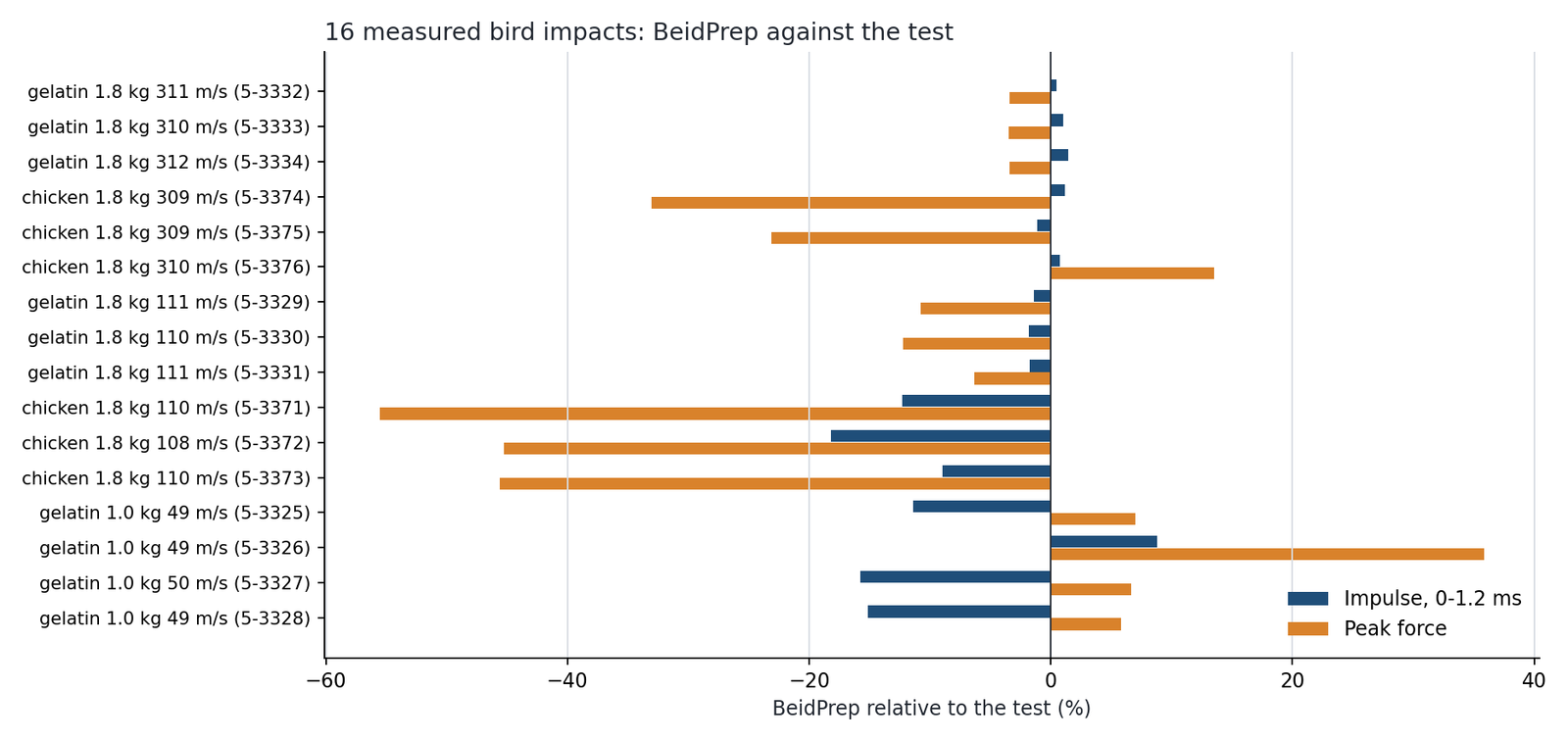
1. Headline
Impulse within 1.8 % of the test (median of 16 impacts); peak force within 11.5 % (median). I compared the force that BeidPrep's bird puts on a flat target with the force measured in 16 published bird impact tests, gelatin projectiles and real chickens, from 49 to 312 m/s.
2. Summary
For the 1.8 kg gelatin projectiles at 110 and 310 m/s, BeidPrep's impulse is within 1.8 % of the test and its peak force within 12.2 %. Across all 16 tests the median difference is 1.8 % on impulse and 11.5 % on peak force. The largest differences are on real chickens, whose peak forces also differ a lot from one test shot to the next, and on 1 kg projectiles at 49 m/s, which the test reports as misaligned at impact.
3. The tests
- Who: NASA Glenn Research Center with the University of Dayton Research Institute (UDRI), the German Aerospace Center (DLR) and Fokker Aerostructures. The impacts were run at the UDRI Impact Physics Laboratory, following the SAE AS6940 test standard.
- What: soft projectiles fired from a compressed-air gas gun at the flat front face of a 305 mm diameter aluminium (Al6061) Hopkinson bar, normal to the face. I used the 16 tests with UDRI gelatin projectiles and real chickens: 1.8 kg gelatin at 310 m/s and 110 m/s (3 tests each), 1.8 kg chickens at 310 m/s and 110 m/s (3 each) and 1 kg gelatin at 49 m/s (4 tests).
- How: the force was computed from strain gauges near the impact end of the bar, sampled at 1.25 million samples per second and low-pass filtered (four-pole Butterworth, 10 kHz, forwards and backwards). Wave reflections inside the bar limit the clean record to about the first 1.2 ms of each impact. Mass and speed of every shot are measured (Table 1 of the reference).
- Reference: J. M. Pereira, K. L. Poormon, S. A. Ritt, W. van de Waerdt, D. M. Revilock, J. C. Akers, Measurement of Artificial and Real Bird Impact on a Very Rigid Flat Surface, NASA/TM-20260001925, April 2026.
4. How I compared
- BeidPrep side: for each test, BeidPrep's Bird panel builds the case from the test's measured mass and speed (Reproduce a test case: the bird, the target and the force output). The target is a rigid flat wall the size of the bar face. I ran each case on OpenRadioss and took the wall's normal force.
- Test side: the force-time curves of the reference, which I digitised from the vector paths in the published PDF (no hand reading). The curves in this report are my own plots of that digitisation; no figure of the reference is reproduced.
- Same treatment: the BeidPrep force goes through the test's own filter (four-pole Butterworth, 10 kHz, forwards and backwards). Both curves start at their own onset, the moment the force first reaches 5 % of its peak, and are compared over the same window: up to 1.2 ms, or to the end of the test record when it stops earlier (three chicken tests at 110 m/s).
- Outputs: the peak force in that window, and the impulse, the area under the force-time curve over the window.
- Difference: (BeidPrep - test) / test x 100 %. Negative means BeidPrep is lower than the test.
5. Results
1.8 kg gelatin projectile, 310 m/s
Test 5-3332. Bird: UDRI gelatin projectile, 1.819 kg. Speed: 310.9 m/s. Target: flat 305 mm bar face (rigid in the model). Angle: normal impact (0 deg).
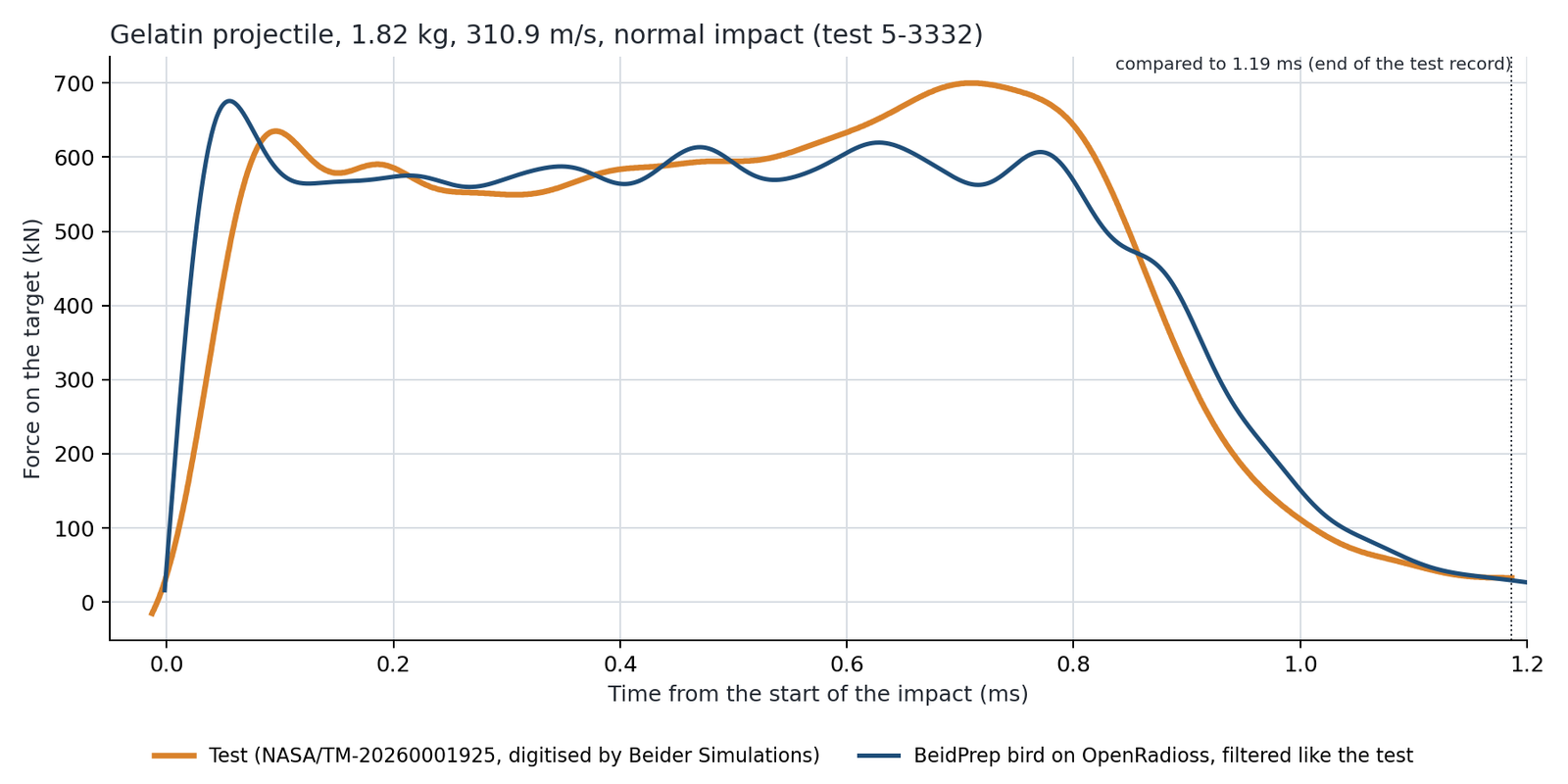
Peak 676 kN against 700 kN in the test (-3.4 %); impulse 547.9 N s against 545.4 N s (+0.5 %).
Test 5-3333. Bird: UDRI gelatin projectile, 1.820 kg. Speed: 310.3 m/s. Target: flat 305 mm bar face (rigid in the model). Angle: normal impact (0 deg).
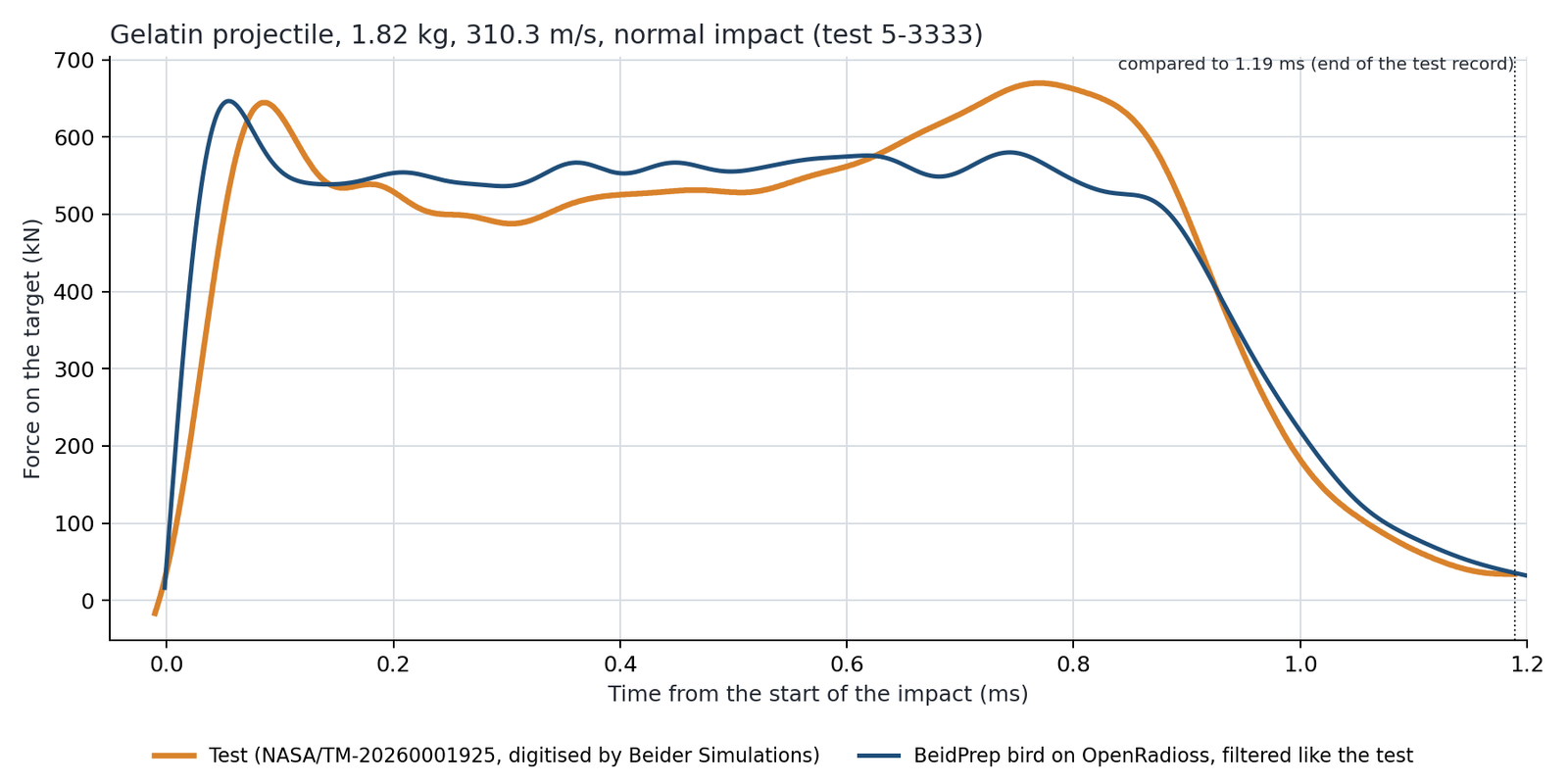
Peak 647 kN against 670 kN in the test (-3.5 %); impulse 546.3 N s against 540.7 N s (+1.0 %).
Test 5-3334. Bird: UDRI gelatin projectile, 1.818 kg. Speed: 311.9 m/s. Target: flat 305 mm bar face (rigid in the model). Angle: normal impact (0 deg).
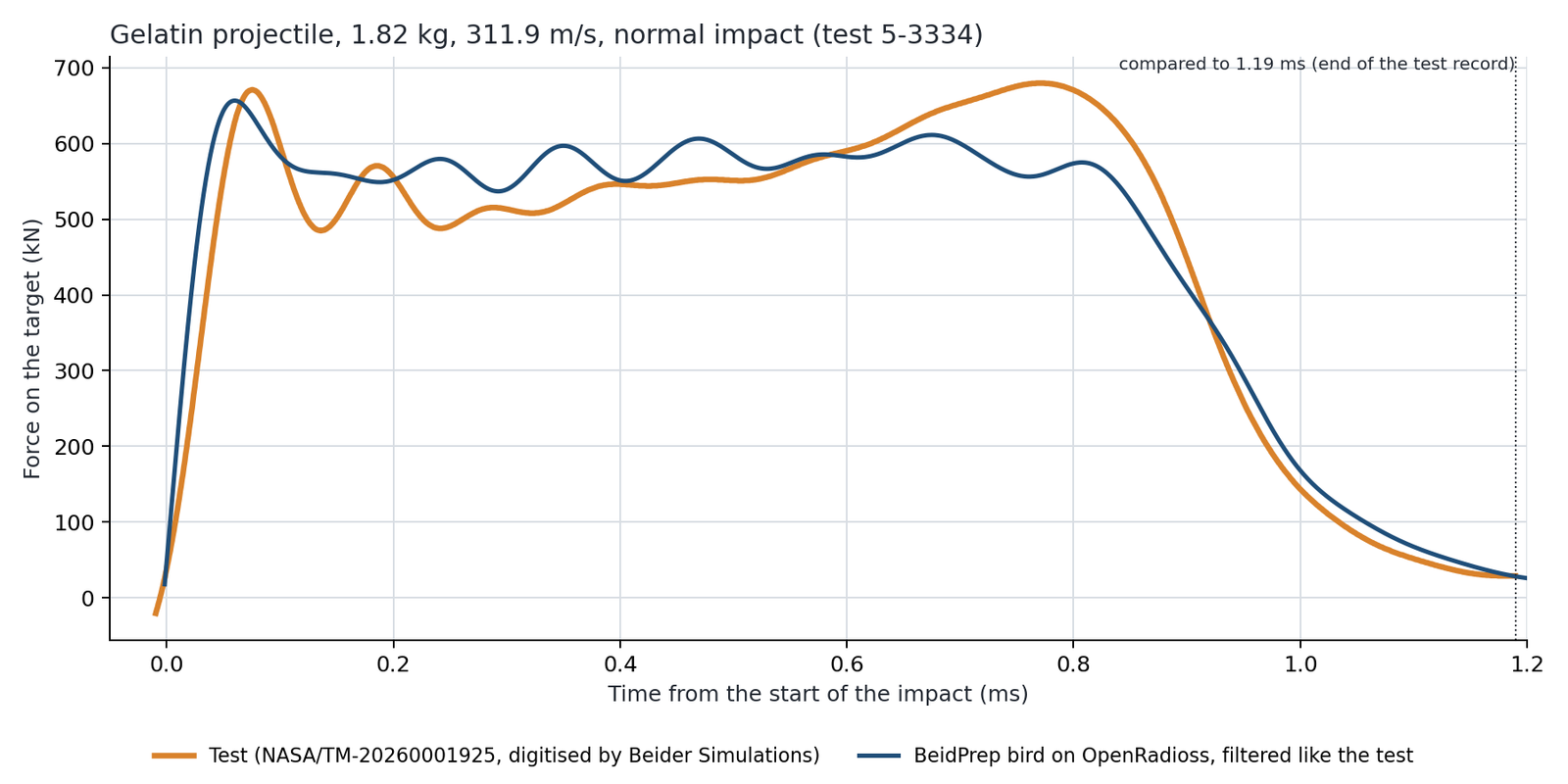
Peak 657 kN against 680 kN in the test (-3.4 %); impulse 549.4 N s against 541.8 N s (+1.4 %).
1.8 kg gelatin projectile, 110 m/s
Test 5-3329. Bird: UDRI gelatin projectile, 1.823 kg. Speed: 110.9 m/s. Target: flat 305 mm bar face (rigid in the model). Angle: normal impact (0 deg).
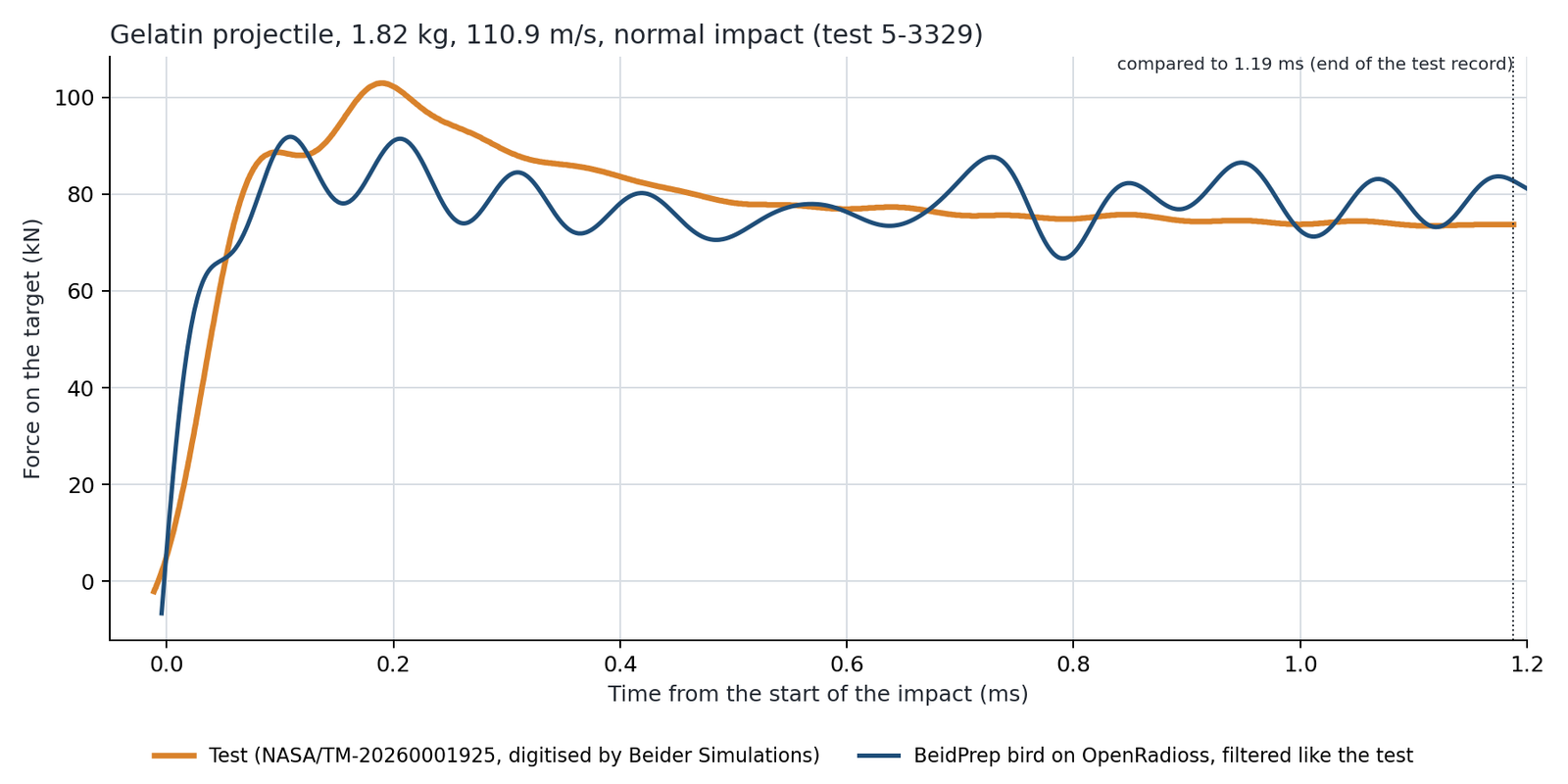
Peak 92 kN against 103 kN in the test (-10.8 %); impulse 91.9 N s against 93.2 N s (-1.4 %).
Test 5-3330. Bird: UDRI gelatin projectile, 1.821 kg. Speed: 110.0 m/s. Target: flat 305 mm bar face (rigid in the model). Angle: normal impact (0 deg).
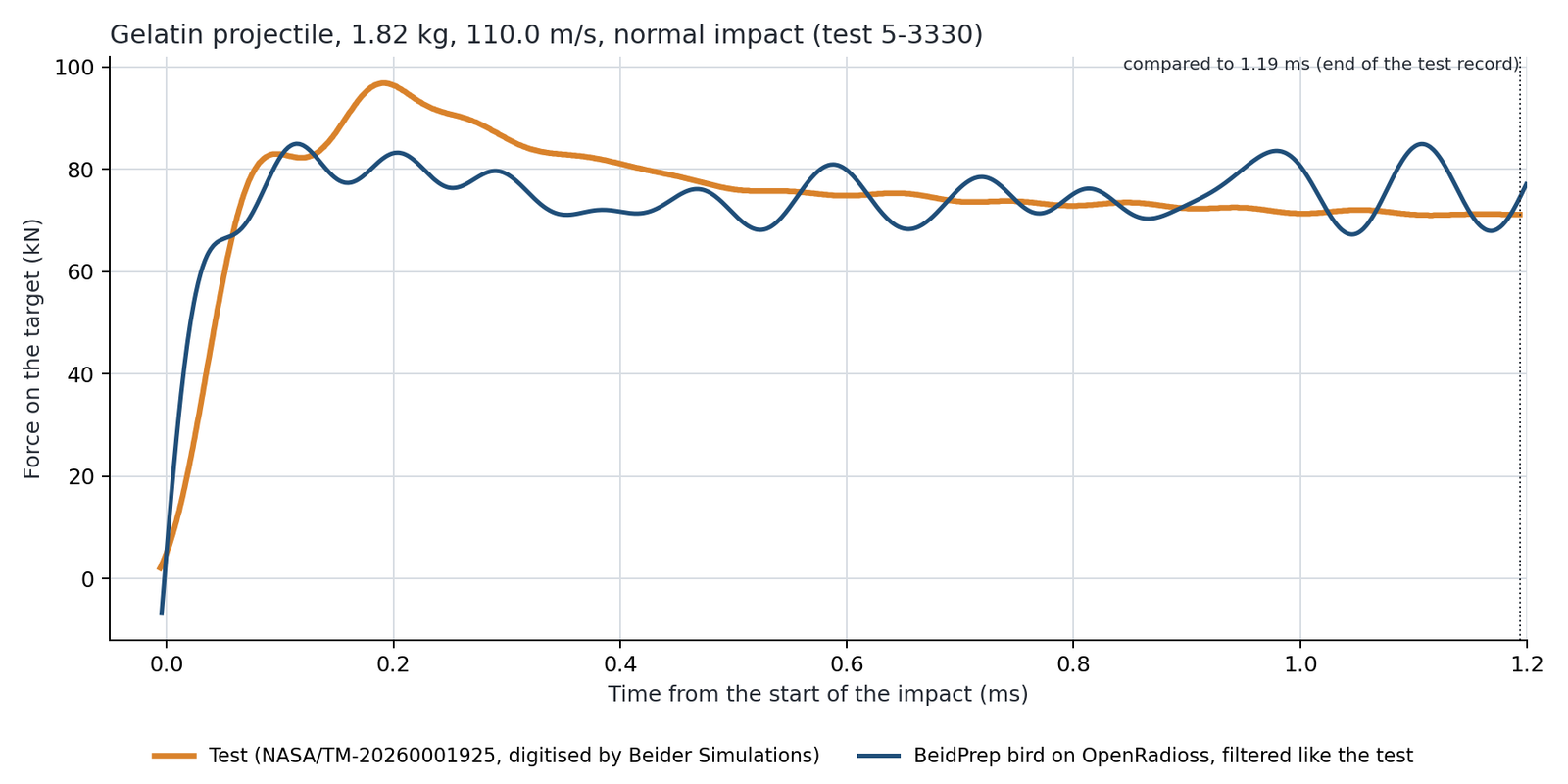
Peak 85 kN against 97 kN in the test (-12.2 %); impulse 88.5 N s against 90.1 N s (-1.8 %).
Test 5-3331. Bird: UDRI gelatin projectile, 1.818 kg. Speed: 110.6 m/s. Target: flat 305 mm bar face (rigid in the model). Angle: normal impact (0 deg).
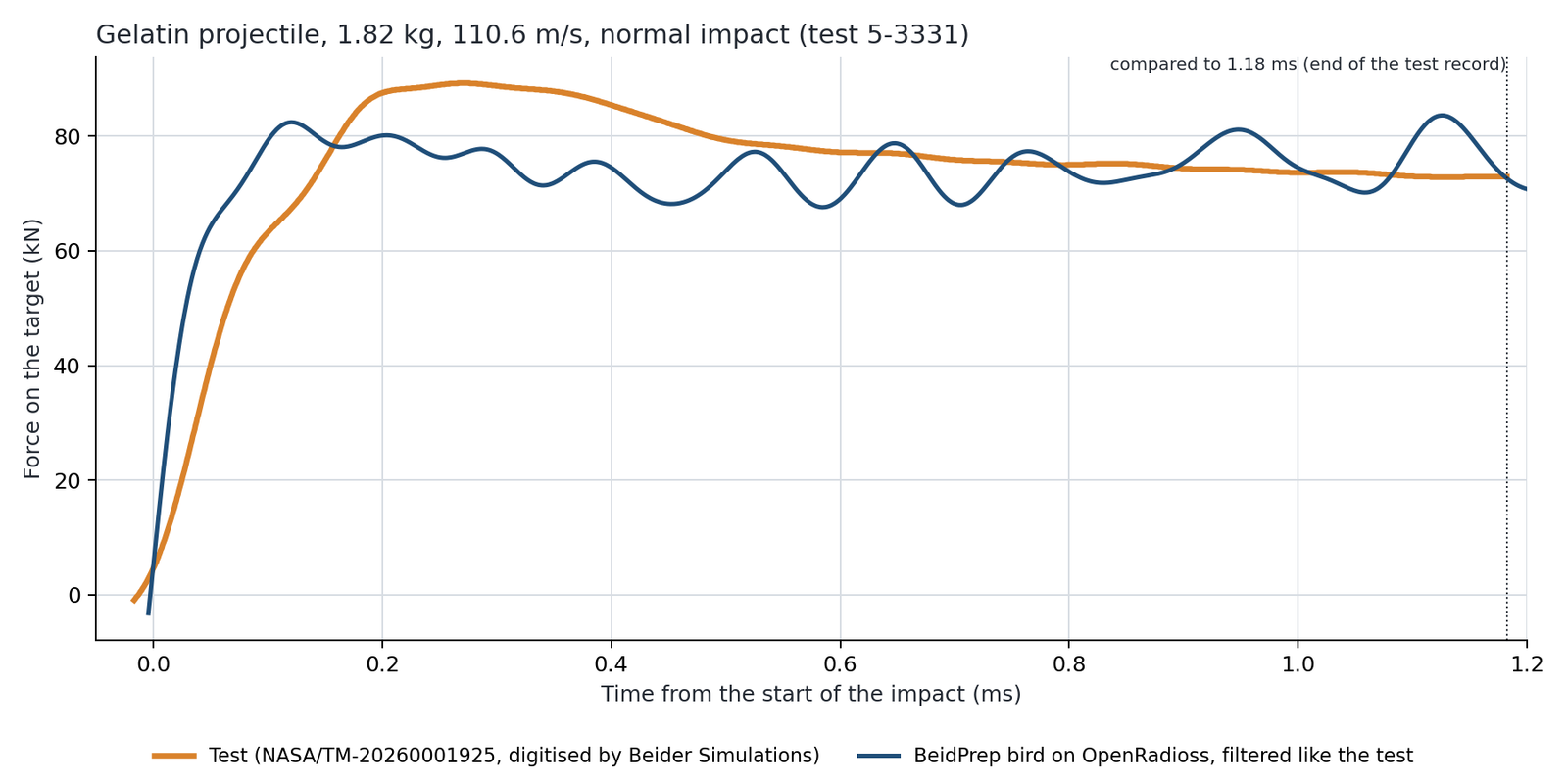
Peak 84 kN against 89 kN in the test (-6.3 %); impulse 86.9 N s against 88.5 N s (-1.7 %), over the 1.18 ms the test recorded.
1.8 kg chicken, 310 m/s
Test 5-3374. Bird: real chicken, 1.817 kg. Speed: 308.9 m/s. Target: flat 305 mm bar face (rigid in the model). Angle: normal impact (0 deg).
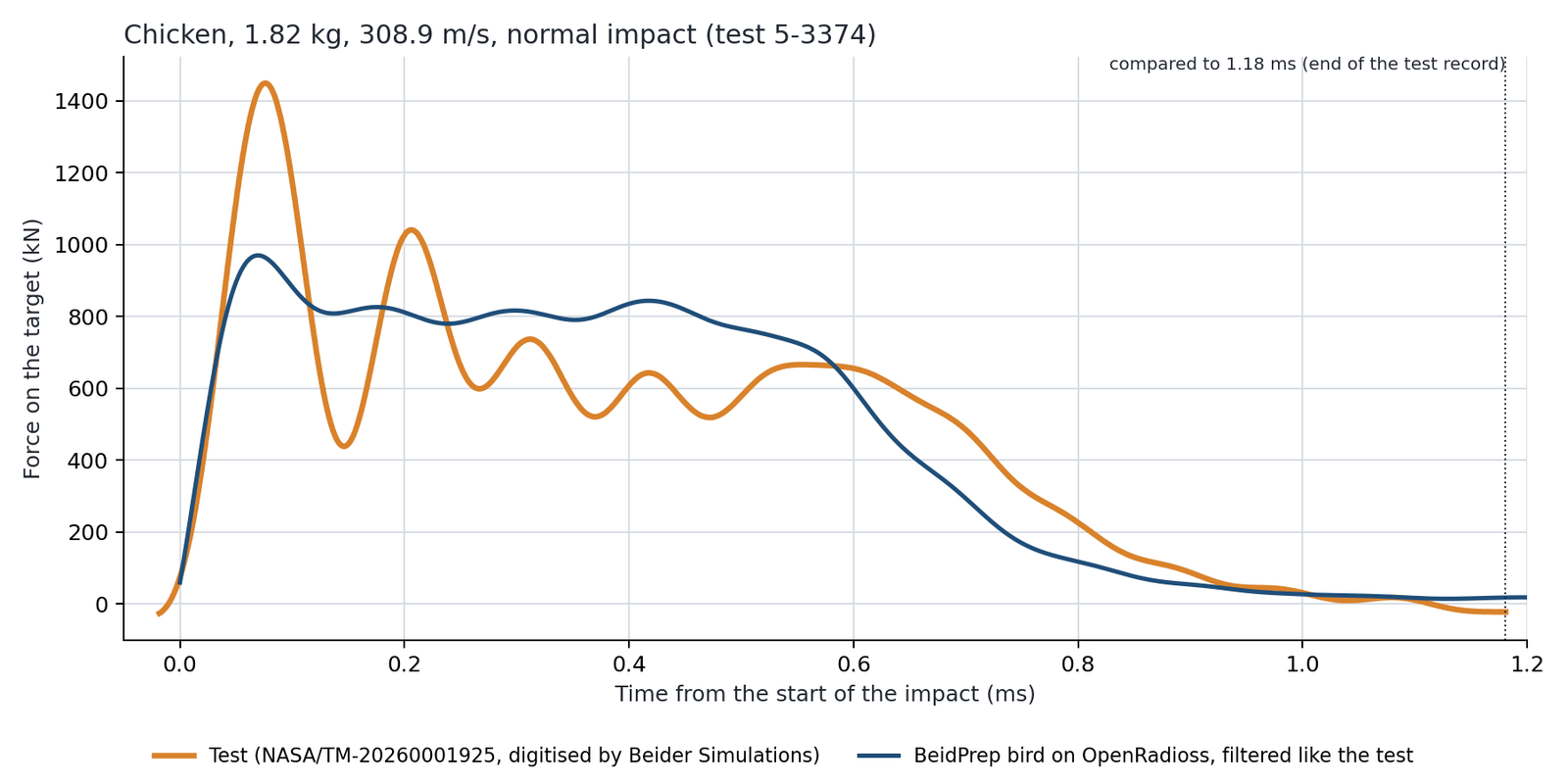
Peak 970 kN against 1449 kN in the test (-33.1 %); impulse 544.8 N s against 538.5 N s (+1.2 %), over the 1.18 ms the test recorded.
Test 5-3375. Bird: real chicken, 1.820 kg. Speed: 309.0 m/s. Target: flat 305 mm bar face (rigid in the model). Angle: normal impact (0 deg).
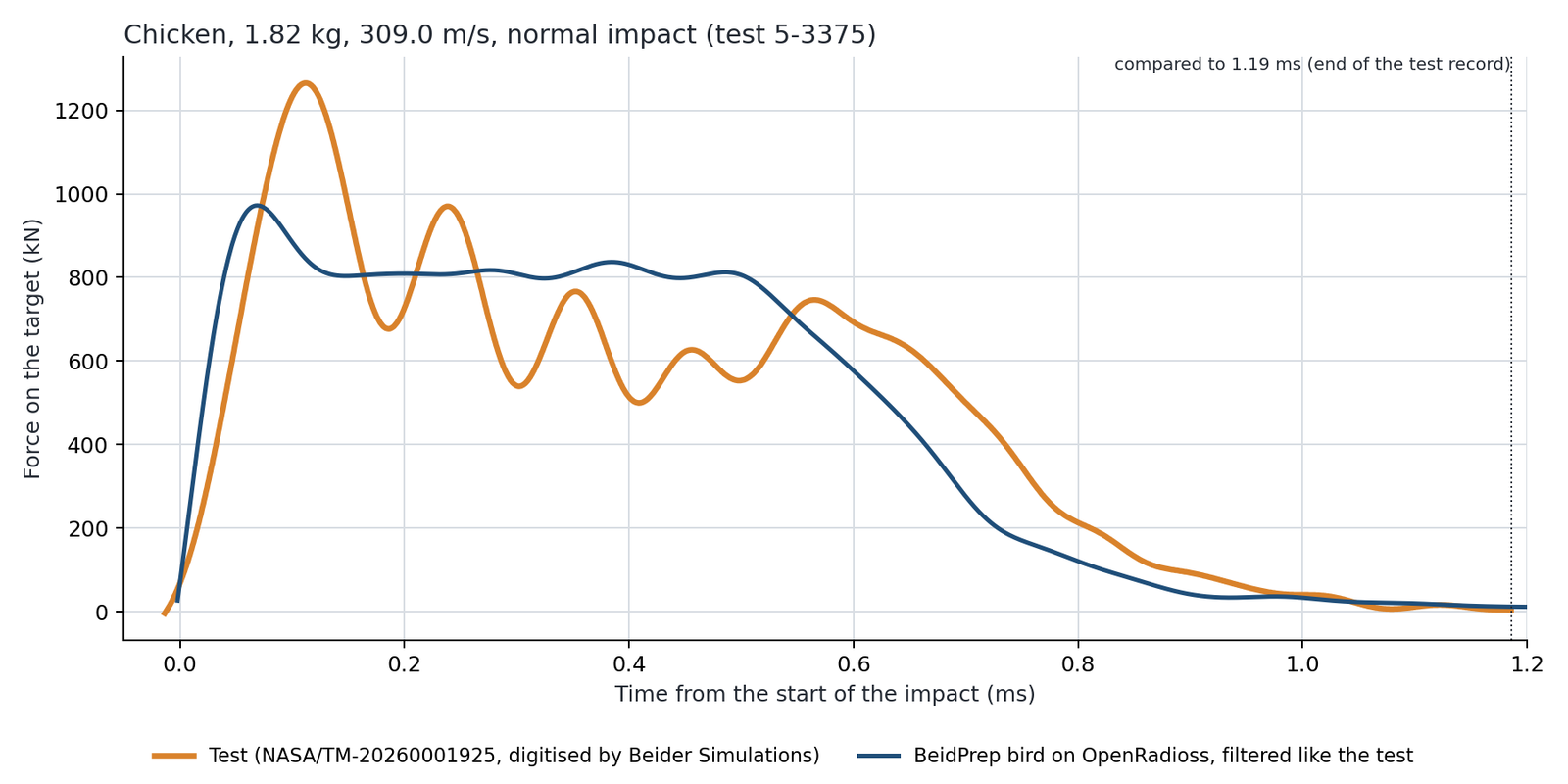
Peak 972 kN against 1265 kN in the test (-23.1 %); impulse 546.4 N s against 552.5 N s (-1.1 %).
Test 5-3376. Bird: real chicken, 1.816 kg. Speed: 309.6 m/s. Target: flat 305 mm bar face (rigid in the model). Angle: normal impact (0 deg).
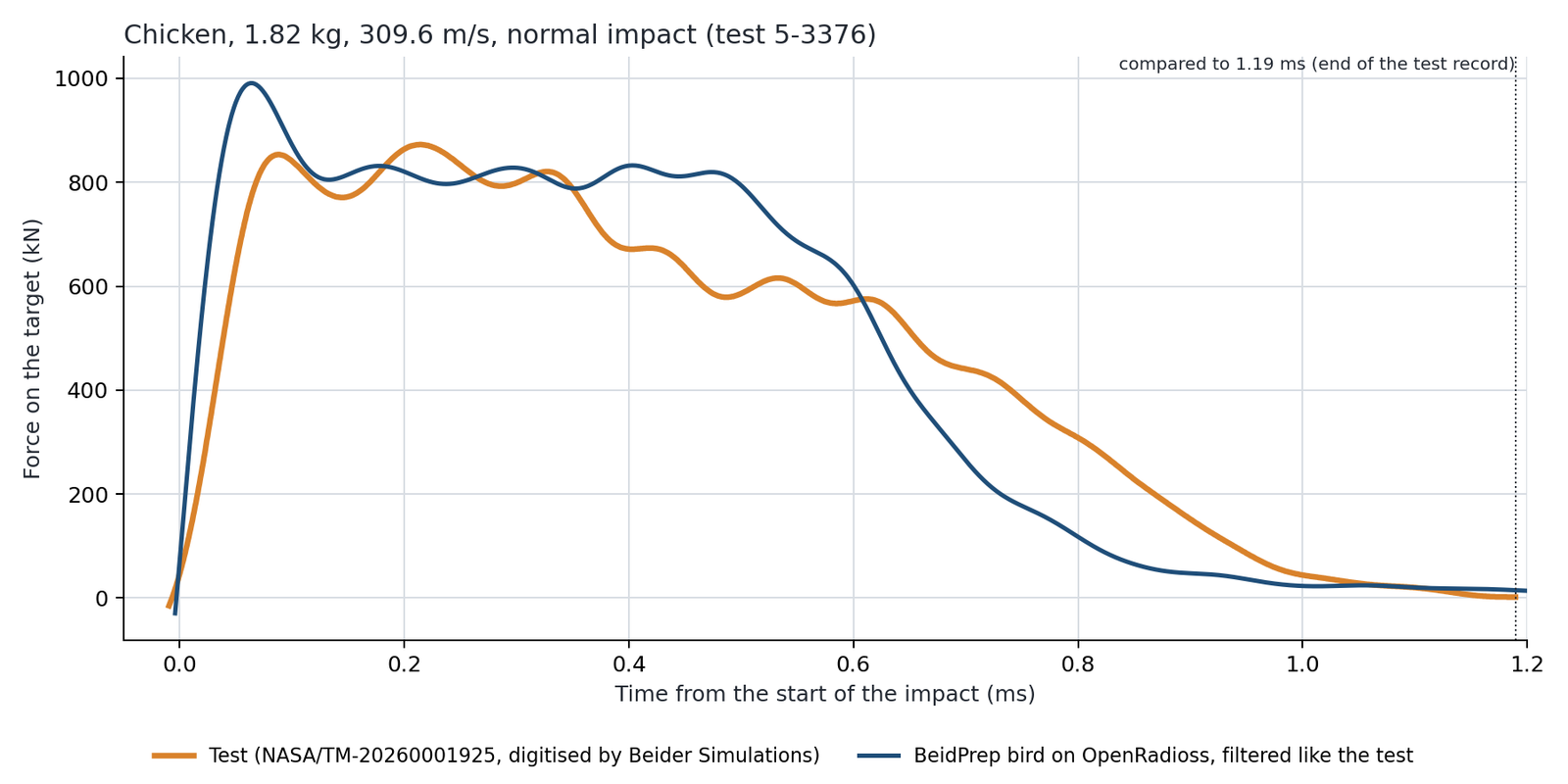
Peak 991 kN against 873 kN in the test (+13.5 %); impulse 547.6 N s against 543.4 N s (+0.8 %).
1.8 kg chicken, 110 m/s
Test 5-3371. Bird: real chicken, 1.817 kg. Speed: 109.8 m/s. Target: flat 305 mm bar face (rigid in the model). Angle: normal impact (0 deg).
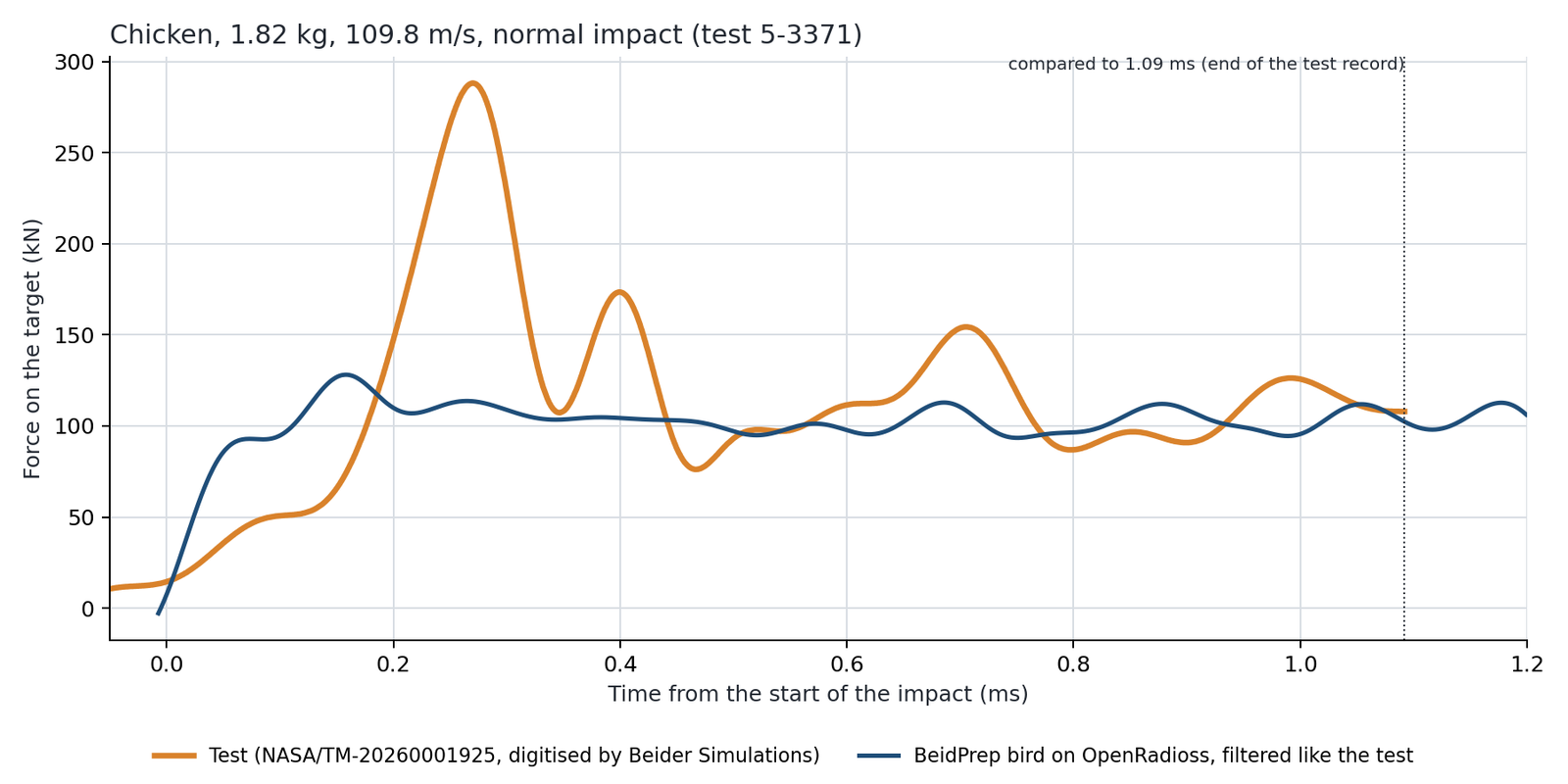
Peak 128 kN against 288 kN in the test (-55.5 %); impulse 110.6 N s against 126.2 N s (-12.3 %), over the 1.09 ms the test recorded.
Test 5-3372. Bird: real chicken, 1.819 kg. Speed: 107.5 m/s. Target: flat 305 mm bar face (rigid in the model). Angle: normal impact (0 deg).
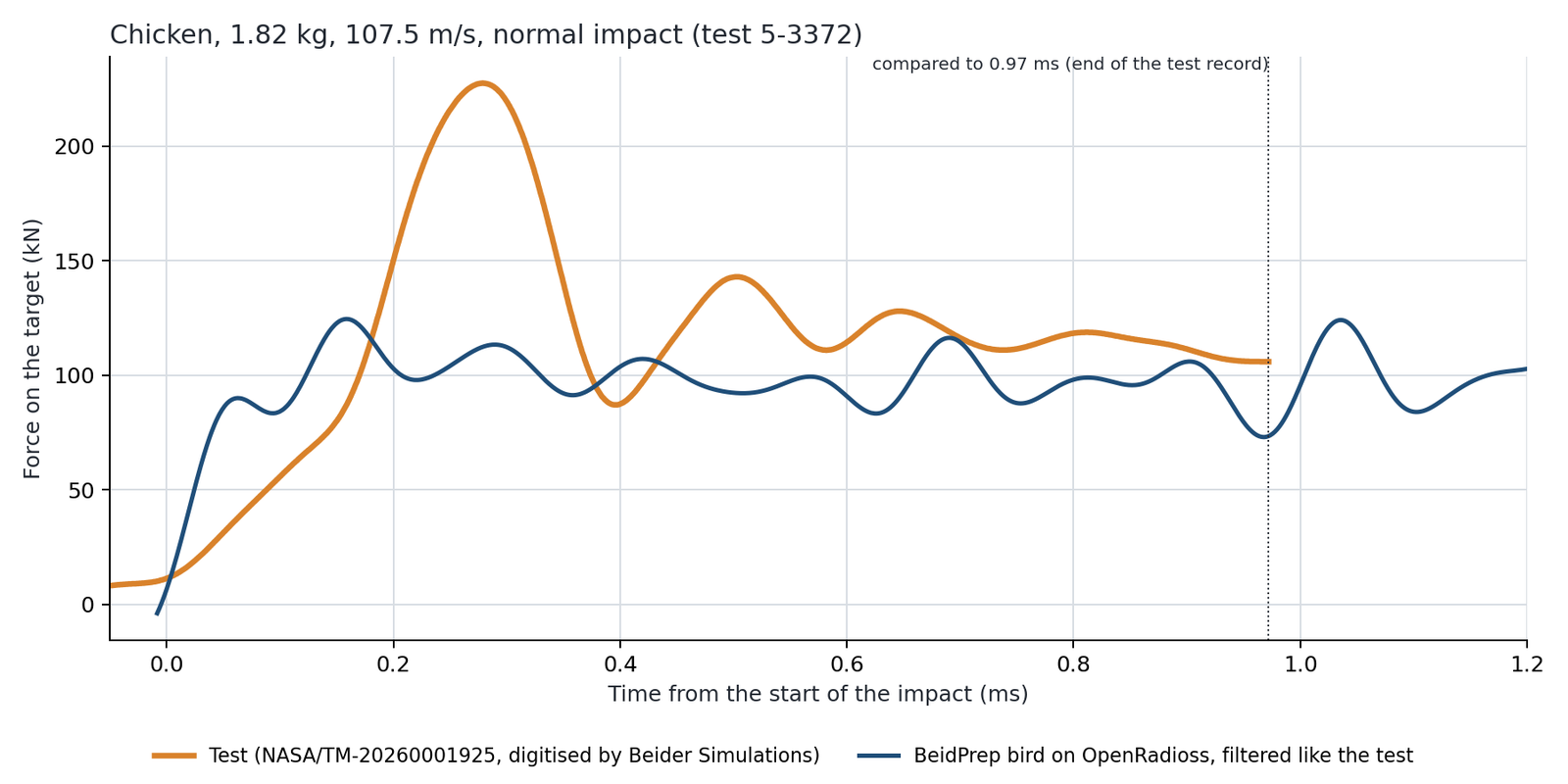
Peak 125 kN against 228 kN in the test (-45.2 %); impulse 93.5 N s against 114.3 N s (-18.2 %), over the 0.97 ms the test recorded.
Test 5-3373. Bird: real chicken, 1.816 kg. Speed: 110.3 m/s. Target: flat 305 mm bar face (rigid in the model). Angle: normal impact (0 deg).
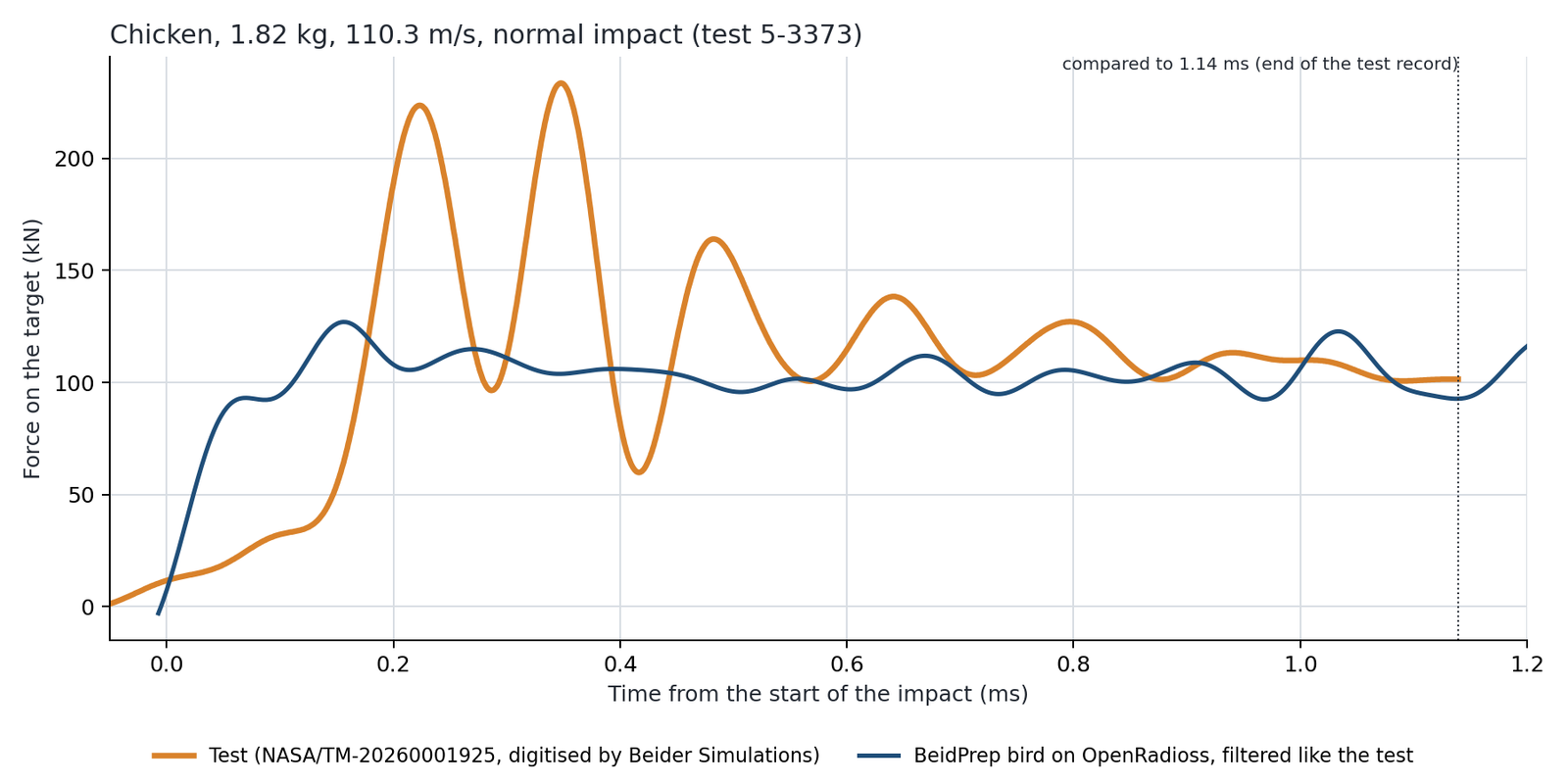
Peak 127 kN against 233 kN in the test (-45.6 %); impulse 116.1 N s against 127.5 N s (-9.0 %), over the 1.14 ms the test recorded.
1 kg gelatin projectile, 49 m/s
Test 5-3325. Bird: UDRI gelatin projectile, 1.008 kg. Speed: 49.1 m/s. Target: flat 305 mm bar face (rigid in the model). Angle: normal impact (0 deg).
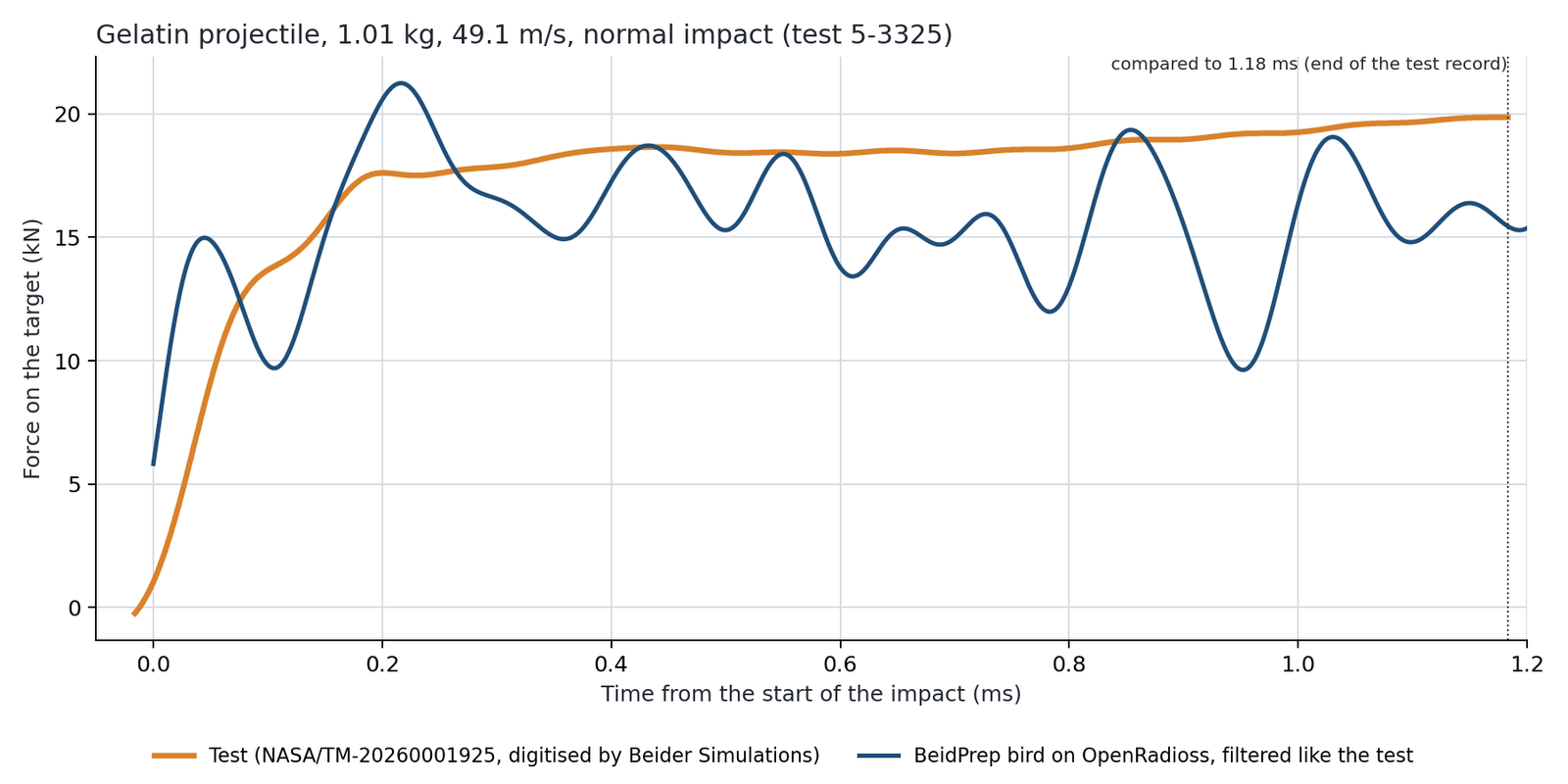
Peak 21 kN against 20 kN in the test (+7.0 %); impulse 18.4 N s against 20.8 N s (-11.4 %), over the 1.18 ms the test recorded.
Test 5-3326. Bird: UDRI gelatin projectile, 1.009 kg. Speed: 49.4 m/s. Target: flat 305 mm bar face (rigid in the model). Angle: normal impact (0 deg).
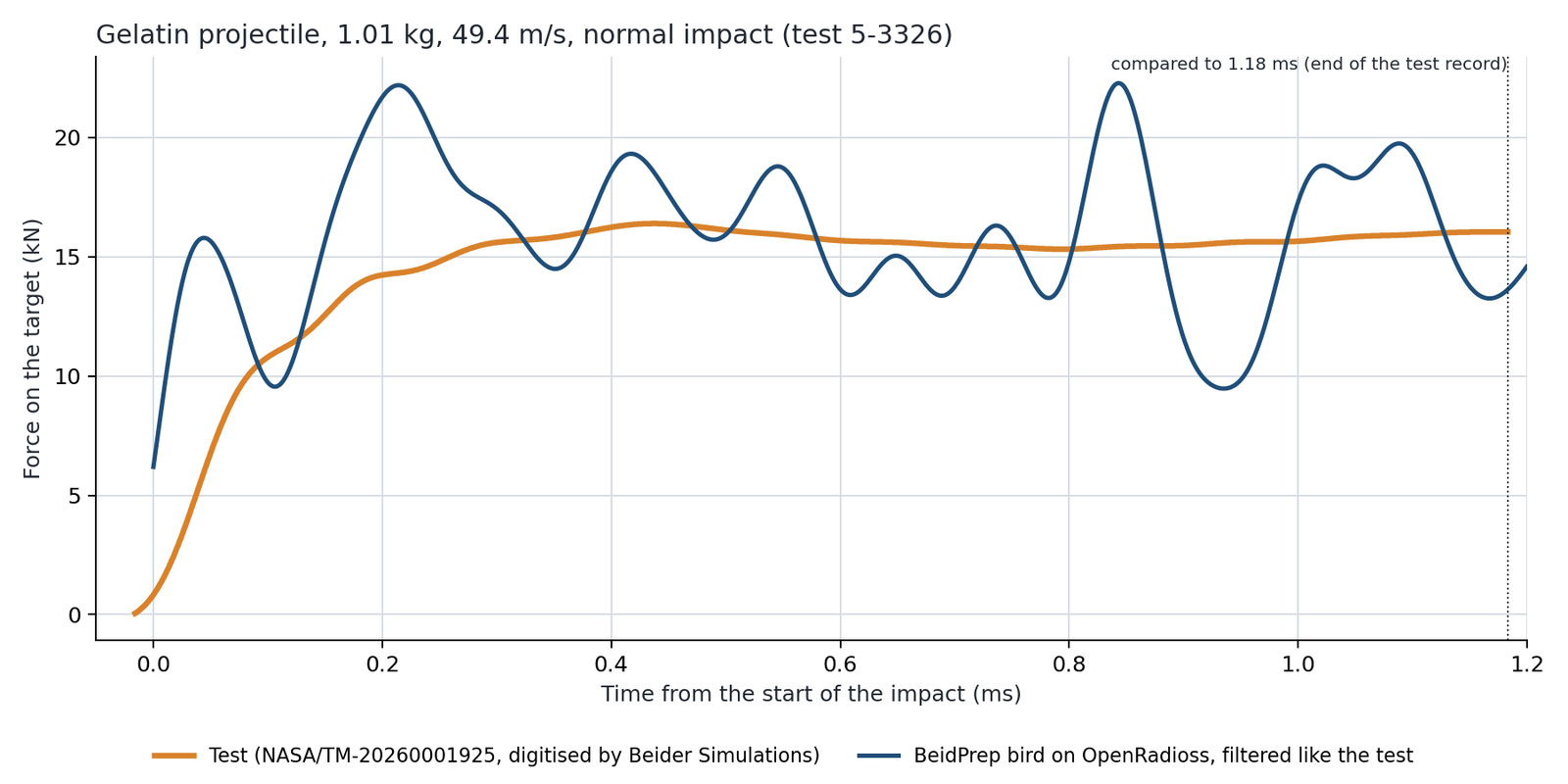
Peak 22 kN against 16 kN in the test (+35.9 %); impulse 18.8 N s against 17.3 N s (+8.8 %), over the 1.18 ms the test recorded.
Test 5-3327. Bird: UDRI gelatin projectile, 1.009 kg. Speed: 49.7 m/s. Target: flat 305 mm bar face (rigid in the model). Angle: normal impact (0 deg).
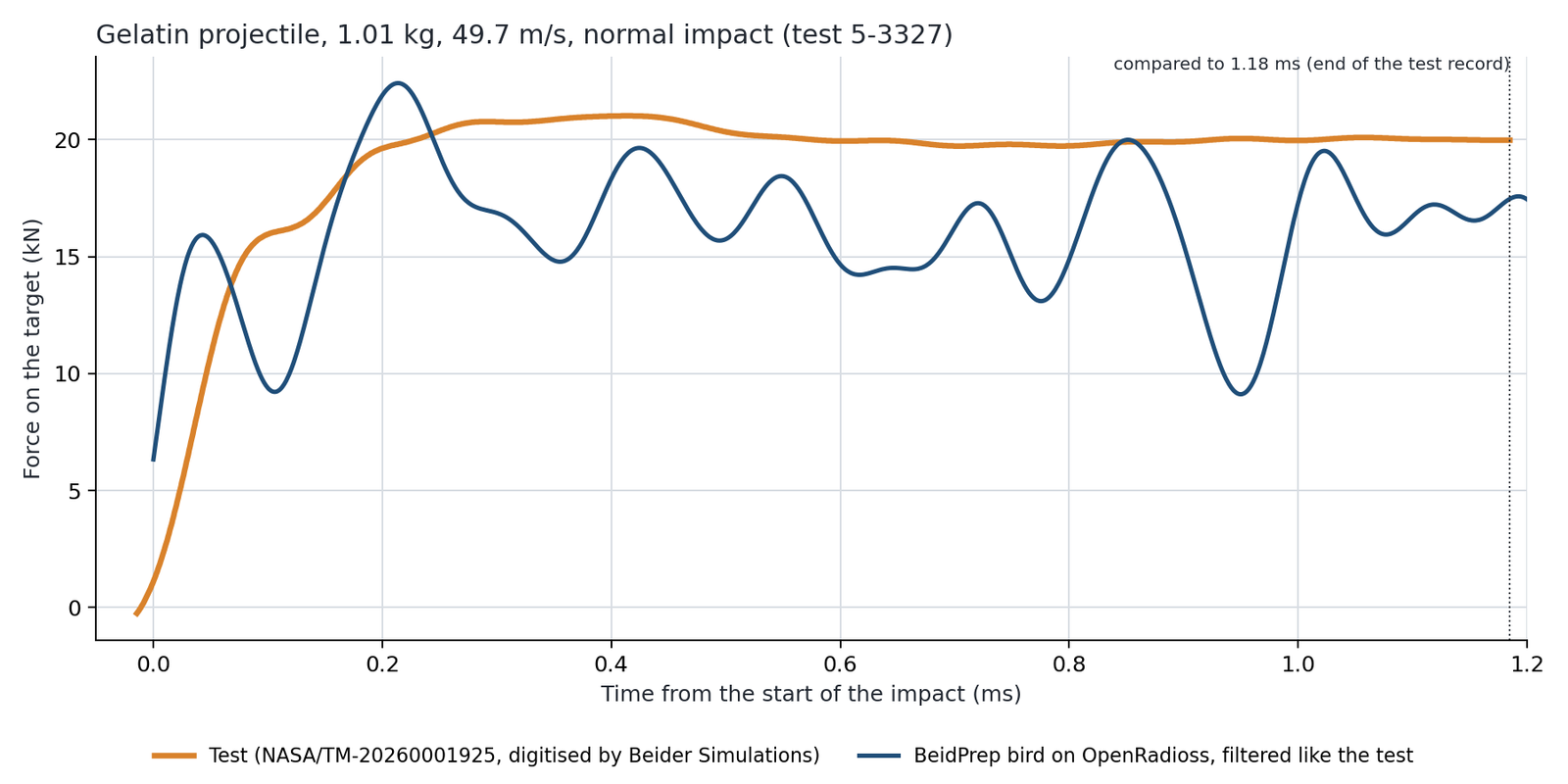
Peak 22 kN against 21 kN in the test (+6.6 %); impulse 19.0 N s against 22.6 N s (-15.8 %), over the 1.19 ms the test recorded.
Test 5-3328. Bird: UDRI gelatin projectile, 1.006 kg. Speed: 49.1 m/s. Target: flat 305 mm bar face (rigid in the model). Angle: normal impact (0 deg).
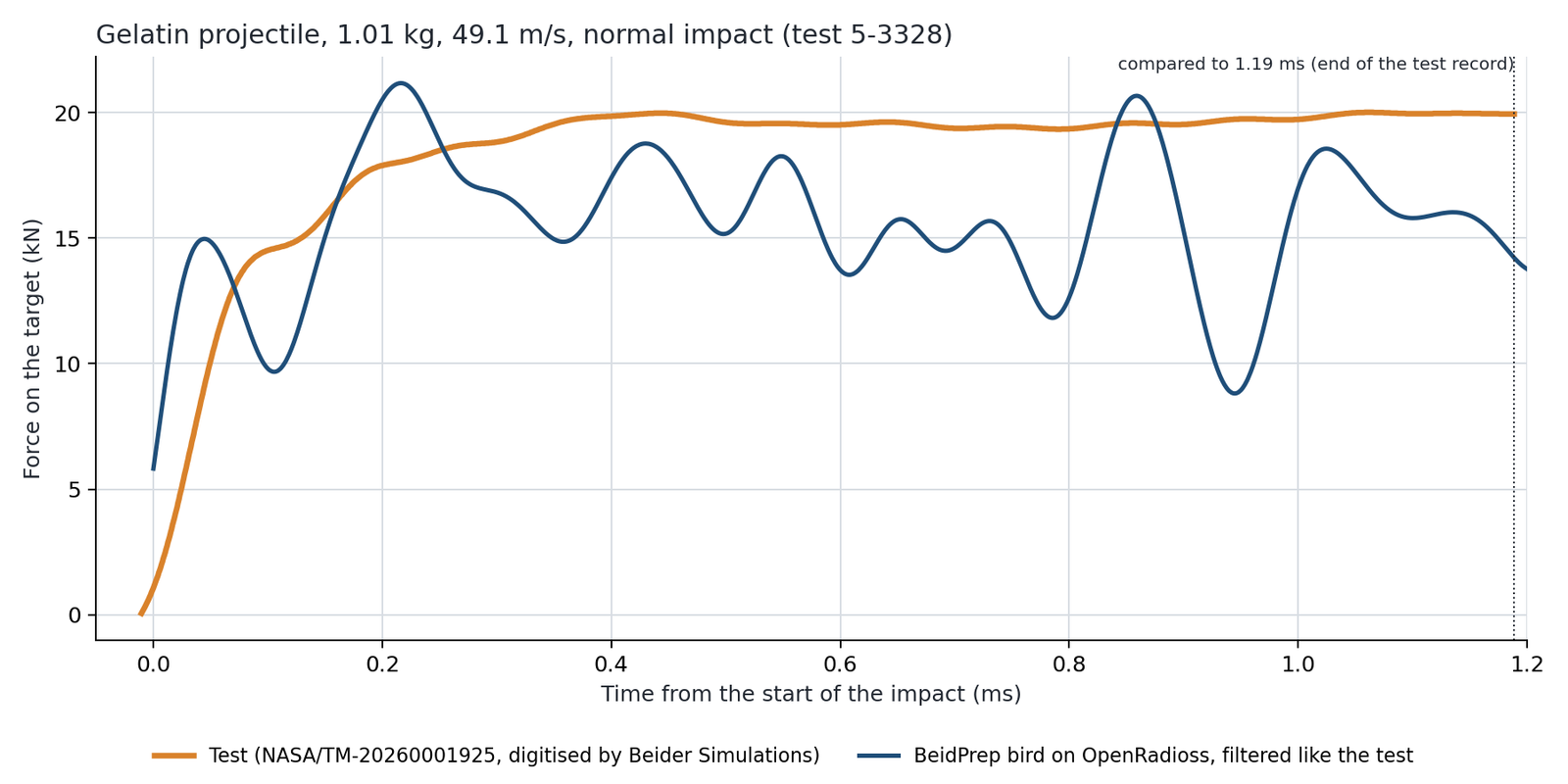
Peak 21 kN against 20 kN in the test (+5.8 %); impulse 18.5 N s against 21.8 N s (-15.2 %).
Table: peak force and impulse
| Test | Bird, mass, speed | Peak test (kN) | Peak BeidPrep (kN) | Diff. | Impulse test (N s) | Impulse BeidPrep (N s) | Diff. | Window (ms) |
|---|---|---|---|---|---|---|---|---|
| 5-3332 | gelatin 1.819 kg, 310.9 m/s | 700 | 676 | -3.4 % | 545.4 | 547.9 | +0.5 % | 1.19 |
| 5-3333 | gelatin 1.820 kg, 310.3 m/s | 670 | 647 | -3.5 % | 540.7 | 546.3 | +1.0 % | 1.19 |
| 5-3334 | gelatin 1.818 kg, 311.9 m/s | 680 | 657 | -3.4 % | 541.8 | 549.4 | +1.4 % | 1.19 |
| 5-3374 | chicken 1.817 kg, 308.9 m/s | 1449 | 970 | -33.1 % | 538.5 | 544.8 | +1.2 % | 1.18 |
| 5-3375 | chicken 1.820 kg, 309.0 m/s | 1265 | 972 | -23.1 % | 552.5 | 546.4 | -1.1 % | 1.19 |
| 5-3376 | chicken 1.816 kg, 309.6 m/s | 873 | 991 | +13.5 % | 543.4 | 547.6 | +0.8 % | 1.19 |
| 5-3329 | gelatin 1.823 kg, 110.9 m/s | 103 | 92 | -10.8 % | 93.2 | 91.9 | -1.4 % | 1.19 |
| 5-3330 | gelatin 1.821 kg, 110.0 m/s | 97 | 85 | -12.2 % | 90.1 | 88.5 | -1.8 % | 1.19 |
| 5-3331 | gelatin 1.818 kg, 110.6 m/s | 89 | 84 | -6.3 % | 88.5 | 86.9 | -1.7 % | 1.18 |
| 5-3371 | chicken 1.817 kg, 109.8 m/s | 288 | 128 | -55.5 % | 126.2 | 110.6 | -12.3 % | 1.09 |
| 5-3372 | chicken 1.819 kg, 107.5 m/s | 228 | 125 | -45.2 % | 114.3 | 93.5 | -18.2 % | 0.97 |
| 5-3373 | chicken 1.816 kg, 110.3 m/s | 233 | 127 | -45.6 % | 127.5 | 116.1 | -9.0 % | 1.14 |
| 5-3325 | gelatin 1.008 kg, 49.1 m/s | 20 | 21 | +7.0 % | 20.8 | 18.4 | -11.4 % | 1.18 |
| 5-3326 | gelatin 1.009 kg, 49.4 m/s | 16 | 22 | +35.9 % | 17.3 | 18.8 | +8.8 % | 1.18 |
| 5-3327 | gelatin 1.009 kg, 49.7 m/s | 21 | 22 | +6.6 % | 22.6 | 19.0 | -15.8 % | 1.19 |
| 5-3328 | gelatin 1.006 kg, 49.1 m/s | 20 | 21 | +5.8 % | 21.8 | 18.5 | -15.2 % | 1.19 |
Window: from the 5 % onset to 1.2 ms, or to the end of the test record. Impulse in N s (kN x ms).
6. The worst cases, and why
Real chickens at 110 m/s (tests 5-3371, 5-3372, 5-3373): peak force -55.5 to -45.2 %, impulse -18.2 to -9.0 %. The reference notes that these birds hit with a flatter front face, which produces a short shock spike at the start of the impact (up to 288 kN here), and that real birds give more high-frequency force than the artificial projectiles, which it links to inhomogeneities such as bones. BeidPrep's bird does not reproduce that spike. The impulse difference is spread over the whole record: part of it is in the first 0.4 ms, where the spike is, and part after it, where these birds pushed harder than the model.
Real chickens at 310 m/s (tests 5-3374, 5-3375, 5-3376): peak force -33.1 to +13.5 %, impulse -1.1 to +1.2 %. The impulse matches. The peak does not, because the three test shots differ widely among themselves: their peaks range from 873 to 1449 kN for birds of the same mass and speed. The reference again names a flatter front face for 5-3374 and 5-3375, the two highest peaks.
1 kg gelatin projectiles at 49 m/s (tests 5-3325 to 5-3328): peak force +5.8 to +35.9 %, impulse -15.8 to +8.8 %. The reference reports significant yaw and pitch misalignment at this lowest speed, and the projectiles flattened and rebounded in one piece. The four tests differ among themselves: peaks 16.4 to 21.0 kN, impulse 17.3 to 22.6 N s. The 1.2 ms record also holds only part of the impact here: about 42 % of the projectile's momentum.
7. Limits
- The target is rigid and flat, and every impact is normal to it. Real structures deform, and real strikes are oblique; the reference itself notes that the initial shock spike matters less there.
- Only the first ~1.2 ms of each impact is compared, because that is what the test records cleanly. At 49 m/s and 110 m/s the impact lasts longer than that.
- The comparison covers the tested masses and speeds: 1.8 kg at 110 and 310 m/s, 1 kg at 49 m/s. Between and beyond them, BeidPrep's Bird panel says whether a bird is inside the tested range.
- The model's bird has no orientation error: it hits straight and level. Several test birds did not, especially at 49 m/s.
- Real birds vary: shape, bones and orientation change the early force. One model bird cannot match every chicken shot, and the peak force of a real bird should be read with that spread in mind.
- The test curves are my digitisation of the published plots; the BeidPrep results come from one solver, OpenRadioss.
8. References
- Pereira, J. M., Poormon, K. L., Ritt, S. A., van de Waerdt, W., Revilock, D. M., Akers, J. C. Measurement of Artificial and Real Bird Impact on a Very Rigid Flat Surface. NASA/TM-20260001925, NASA Glenn Research Center, April 2026. Measured values used with this citation; the test curves shown are Beider Simulations' own digitisation.
- OpenRadioss, open-source explicit finite element solver: https://www.openradioss.org